
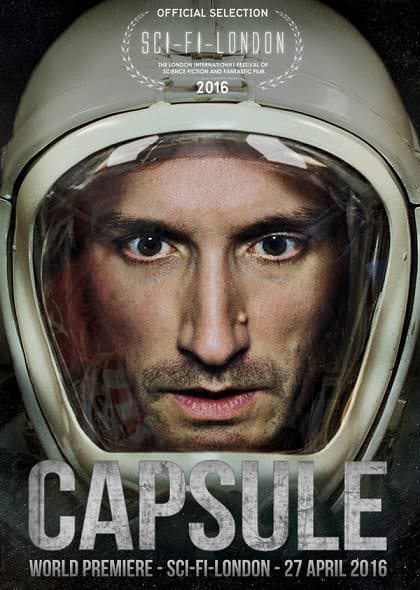
There are space movies that dazzle you with cosmic vistas and explosions — Gravity, The Martian, Interstellar — and then there’s Capsule (2015), which quietly pulls you into the headspace of one man who’s just trying to make it home alive.
Directed by Andrew Martin, this British sci-fi drama is set in 1959, during the height of Cold War paranoia. The story follows Guy Taylor, played by Edmund Kingsley, a British test pilot chosen for the UK’s first manned space mission. Once in orbit, everything starts to go wrong — equipment malfunctions, radio signals cut out, and every breath inside the tiny capsule feels like it might be his last.
Not What It Seems
I’ve seen plenty of “astronaut in danger” movies, but what struck me about Capsule is how small and human it feels. Just like Alex Billington wrote in his review of Capsule the movie here’s no sweeping score or endless CGI; just Guy, his flickering instruments, and voices crackling through static. Sometimes he’s speaking with British command, sometimes it’s the Americans or the Russians — and at a certain point, even we’re not sure who’s really on the other end.
The film relies almost entirely on Kingsley’s performance, and honestly, he carries it well. He manages to convey panic, exhaustion, and eerie calm all within that cramped cockpit. It reminded me of Sam Rockwell in Moon (2009) — another one-man sci-fi drama that thrives on atmosphere rather than spectacle.
Comparisons to Other Sci-Fi Drama / One-Man / Isolation Films
To appreciate where Capsule fits in the landscape of sci-fi dramas, here are a few comparison points:
| Film | Similarities | Key Differences / Contrast |
|---|---|---|
| Gravity (2013) | High tension in space; life-support failure; isolation. | Gravity has more dynamic visuals, rescue attempts, multiple protagonists; more spectacle. |
| Moon (2009) | Isolation, psychological strain, limited cast, internal conflict | Moon has more elaborate mystery and identity twist; more developed world-building |
| The Martian (2015) | Survival under constrained resources, ingenuity under duress | More upbeat tone, more external interaction, larger scale |
| Cast Away (2000)* (non-sci fi) | The idea of one person battling environment & loneliness | Cast Away is terrestrial and survival is more physical and less technical |
Like Gravity (2013), Capsule uses isolation as its real antagonist. But while Sandra Bullock’s journey is a fight against chaos, Guy’s feels like a battle against silence and mistrust — political, personal, even psychological. You can almost feel the air thinning with every minute.

Visually, Capsule makes the most out of its limitations. This film like other Sci-Fi Movies takes place inside that metal shell, and yet it never feels lazy. Instead, the claustrophobia becomes part of the storytelling — you feel trapped with him, counting seconds, waiting for a voice to break the silence.
It’s definitely not for everyone — the pacing is slow, and it leans more toward psychological tension than action. But if you like your sci-fi with a touch of realism, a dash of historical context, and a focus on human endurance, it’s worth watching.
Conclusion
For me, Capsule sits somewhere between Gravity and Moon, but with a distinctly British flavor — quiet, tense, a little melancholic, and full of understated bravery. It’s the kind of film that makes you appreciate how fragile both technology and human faith can be when you’re floating alone above the Earth.