
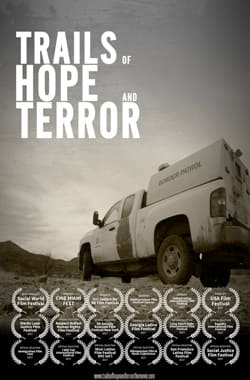
Trails of Hope and Terror (2017) – A Haunting Documentary of Migration and Humanity
The documentary Trails of Hope and Terror (2017), directed by Vincent De La Torre, takes viewers into the perilous journeys of Central American and Mexican migrants who cross the U.S. border—fueled by hope, terror, necessity, and the weight of history. The film does not just ask “Why do they come?” but also challenges the systems that make such journeys almost inevitable.
Overview of the Film
With a runtime of approximately 53 minutes, Trails of Hope and Terror combines first-hand testimonies, desert footage, interviews with humanitarian workers and legal professionals, and a framing of the long arc of U.S.–Latin American border policy—from NAFTA and Operation Gatekeeper through to modern crises. The two young women featured in the film, Sandra and Josseline, become emblematic of thousands whose journeys are tethered to both aspiration and risk.

Festival Recognition & Reception
One of the film’s remarkable achievements is that it was selected for over 18 film festivals, underscoring both its relevance and global resonance—though it remains under-seen in mainstream circles. Trails of Hope and Terror has gathered positive reviews and strong audience responses during its festival run. According to its IMDb page, it has drawn favorable feedback for its unflinching look at migration and its moving documentary style.
Positive Critical Comments
The film received praise from CWMission.org for its compassionate and insightful portrayal of migration, describing it as “a powerful document of the invisible journeys” and “a film that lets migrants speak, rather than being spoken about.” On IMDb, many reviewers also commend the film for its authenticity and empathy, calling it “one of the most humane migration documentary movies” and “a story that stays with you long after watching.”
My Personal Thoughts – Why It Resonated
Watching Trails of Hope and Terror felt like a wake-up call. What struck me most was how it captured both the vastness of the desert and the intimacy of each person’s story. It made me pause and consider: when someone walks through that landscape, what are they imagining? What have they lost, and what are they risking?
The film doesn’t sensationalize the journey—it respects the people. And that restraint becomes its strength. I found myself especially moved by the contrast between the hopeful moments (small smiles, glimpses of community) and the harsh realities (border patrol, harsh terrain, legal limbo). It left me asking: what would I do if I had to choose between leaving everything or staying and slowly ceasing to exist?

What It Does So Well
- It gives voice to those often reduced to statistics.
- The visual language—desert landscapes, truck rides, border crossings—is immersive without being exploitative.
- It places individual stories in a broader historical and moral context, showing that the “trail” is part of a much longer journey.
- Its selection at over 18 festivals and positive audience feedback show that it resonates across cultures.
Where It’s Less Strong (From My View)
That said, the film’s 53-minute format means it can’t explore every angle. Some viewers might want more legal or policy background, or longer follow-ups with the migrants after their crossings. Also, while the film is emotionally compelling, its modest production values might feel raw to some. But to me, that honesty adds to its authenticity—it feels made by people who care more about truth than polish.

Conclusion
Trails of Hope and Terror (2017) is a vital documentary that deserves wider attention. It defies easy categorization—as social-issue film, migration study, or human drama—and yet these elements converge with powerful effect. For anyone interested in migration, human rights, or simply in understanding the courage behind the headlines, this film is a must-see.
If you’re ready to be challenged, moved, and reminded of our shared humanity, Trails of Hope and Terror will stay with you long after the screen fades to black.